How to Actually Fix Your Pricing (Without Guessing)
Most people try to fix pricing by picking a number.
That’s the wrong approach.
Before you change anything, you need to answer three questions:
Is your own pricing consistent?
Do you understand your market?
Are you underpriced, under-skilled, or under-positioned?
This guide will walk you through all three.
Step 1: Is Your Pricing Actually Consistent?
Before you look outward, look inward.
A lot of businesses think they have a pricing problem—but what they really have is inconsistency.
Ask yourself:
Do you price the same type of job the same way every time?
Do similar designs have similar pricing?
Could you explain your pricing clearly to a client?
Or does it change depending on the inquiry, mood, or timeline?
What inconsistency looks like:
“Starting at” pricing with no clarity
Different quotes for similar installs
Making it up every time
Discounting to close deals
Why this matters:
When your pricing isn’t consistent, clients feel it.
It creates hesitation, comparison shopping, and slower decisions.
Your goal:
Create standards you can repeat.
Not rigid—but reliable.
Remember this:
Consistency builds trust.
Trust supports pricing.
Step 2: Run a Real Pricing Audit in Your Area
Now it’s time to go outside your business.
This is where most people either:
Avoid doing the work
Or only look at surface-level pricing
Instead, you’re going to run a full recon mission.
Step-by-Step: How to Audit Your Market
1. Identify 5–10 local competitors
Look for businesses that:
Serve similar clients
Offer similar types of installs
Are active and visible
2. Evaluate more than just price
For each one, look at:
Skill level
Clean installs?
Design complexity?
Attention to detail?
Perceived value
Do their photos look professional?
Is their branding strong?
Do they feel “premium” or “budget”?
Pricing
Do they show pricing?
If yes, what’s the range?
If not, what can you estimate based on their work?
Customer experience
Is it easy to inquire or book?
Do they guide the client clearly?
Or is it confusing and manual?
3. Look for patterns (this is the key)
You’re not trying to copy anyone.
You’re trying to understand:
Who looks busy?
Who looks premium?
Who makes it easy to book?
Who is clearly undercharging?
Who is charging more—and why?
Don’t just compare prices.
Compare the entire experience.
Step 3: Use the Pricing Audit Worksheet
To make this easier, we created a simple worksheet you can use to track everything.
👉 Download the Pricing Audit Worksheet
How to use it:
For each competitor, fill in:
Skill level (low / medium / high)
Perceived value (low / medium / high)
Estimated pricing
Notes on branding, photos, and booking experience
Then step back and review:
Where do most businesses sit?
Where are the gaps?
Who is charging more—and what are they doing differently?
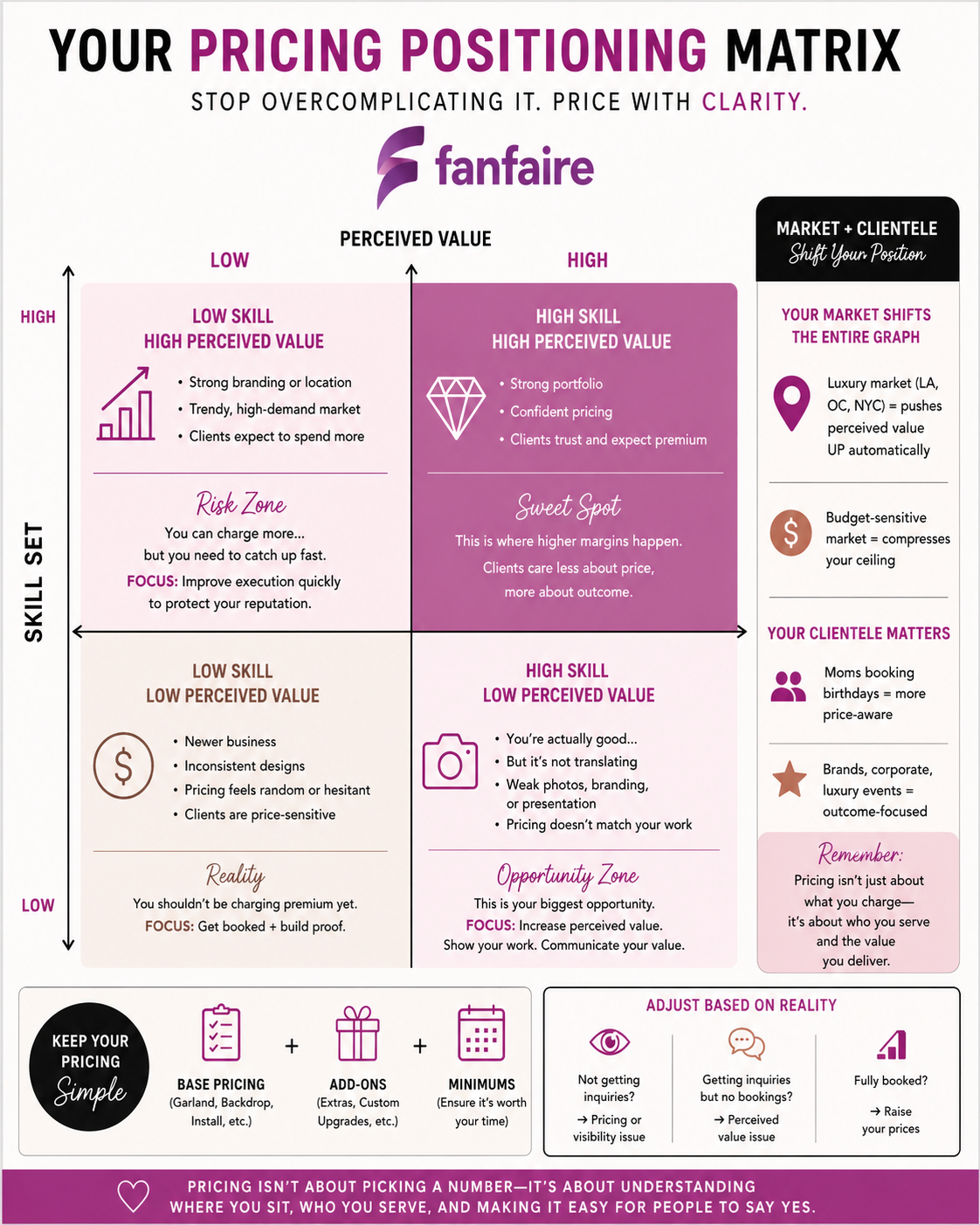
Step 4: Identify Where You Actually Sit
Now the honest part.
Based on what you found, ask:
Which quadrant am I really in?
Low Skill / Low Perceived Value
You’re still building
Pricing feels unclear
Clients are price-sensitive
👉 Focus on:
Skill development
Consistency
Getting booked + building proof
Low Skill / High Perceived Value
You’re getting bookings
But execution needs to catch up
👉 Focus on:
Improving delivery quickly
Protecting your reputation
High Skill / Low Perceived Value
Your work is strong
But clients don’t see the value
👉 Focus on:
Photos, branding, presentation
Clear pricing + packages
A better client experience
High Skill / High Perceived Value (Goal)
You’re trusted and in demand
Pricing feels aligned
👉 Focus on:
Raising strategically
Protecting your time
Scaling your process
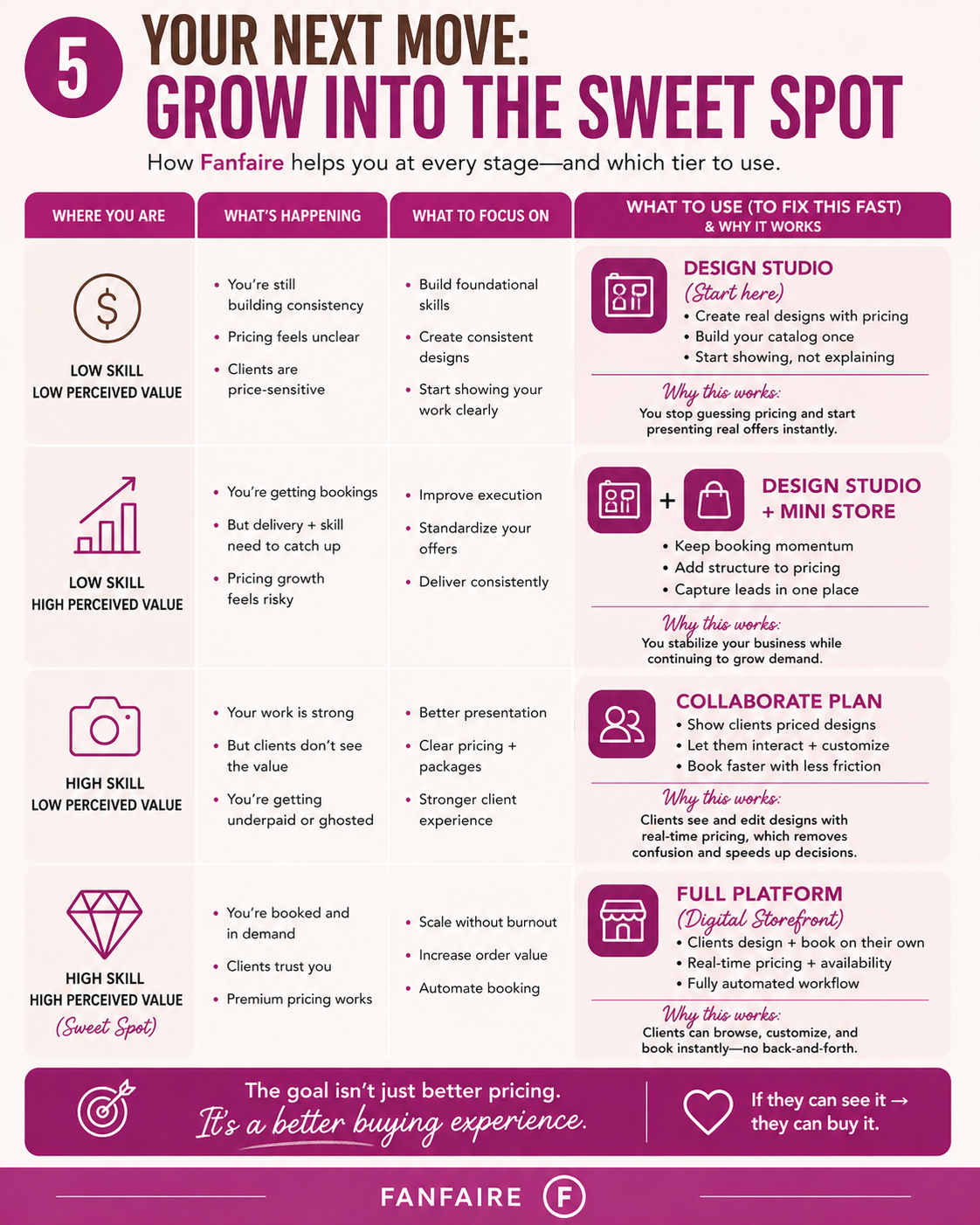
Step 5: Decide What Actually Needs to Change
This is where most people go wrong.
They jump to:
“I need to raise my prices.”
But based on this audit, your real next move might be:
Improve your skills
Fix your pricing structure
Upgrade your photos
Make booking easier
Show your work more clearly
Or increase visibility
Final Thought
Pricing isn’t something you “set once.”
It’s something you grow into.
And the fastest way to grow into better pricing is:
clarity
consistency
and understanding your position in the market
If you do this exercise honestly, you’ll know exactly what to fix next.
No guessing required.